
AI WON’T REPLACE GOOD AUTHORS. BUT IT MIGHT MAKE AVERAGE WRITING EVEN MORE AVERAGE.
Why the future belongs to writers who refuse to sound like everyone else.
If you’ve spent any time in the publishing world recently, you’ve probably noticed that every conversation eventually circles back to artificial intelligence. Depending on whom you ask, AI is either the greatest innovation to happen to writers since the word processor or the beginning of the end for creativity itself. Some claim that authors who refuse to embrace it will soon become irrelevant, while others insist that using it in any capacity compromises the integrity of the written word.
Neither perspective feels entirely right to me.
That became even clearer during a recent conversation I had with entrepreneur, engineer, editor, and writer Eric Miller of the Phoenix Writers Club on our vlog, Publishing Mastery Talks. Because Eric works with AI every day in the technology world while also writing professionally, I was curious to hear how someone who understands the technology from the inside approaches it as a writer. Rather than fueling the fear or celebrating the hype, our conversation settled into a far more interesting question: How do we take advantage of new technology without losing the very thing that makes readers want to read us in the first place?
AI Is an Incredible Assistant but a Terrible Replacement for Human Creativity
One of the most interesting observations Eric shared was that AI excels at exactly the kinds of tasks most writers don’t particularly enjoy. It can sift through large amounts of information in seconds, summarize research, suggest historical details, identify inconsistencies, and catch grammatical errors before a manuscript reaches a professional editor. Used thoughtfully, it can save hours of tedious work.
Writing, however, isn’t a tedious task. At least it shouldn’t be.
A novel, memoir, or nonfiction book is far more than a sequence of grammatically correct sentences. Every chapter carries the weight of the author’s experiences, beliefs, observations, and emotional life. Readers don’t simply absorb information; they enter another person’s way of seeing the world. That is something no algorithm, no matter how sophisticated, can genuinely recreate.
AI learns by recognizing patterns across enormous amounts of existing content and producing an answer that represents the statistical average of what it has learned. In other words, it naturally gravitates toward consensus. It smooths rough edges. It removes surprises. It quietly nudges everything toward the middle.
That is incredibly useful when you’re looking for information. It is much less useful when you’re trying to create art.
The writers we admire most rarely became memorable because they sounded like everyone else. We remember them precisely because they didn’t. Their voices carried something unmistakably their own, whether it was Hemingway’s restraint, Toni Morrison’s lyricism, Joan Didion’s precision, or Anne Lamott’s honesty. Their work could never have been created by averaging what everyone else had already written.
For that reason, I see AI as an assistant rather than a replacement. Let it help you research unfamiliar topics. Ask it to explain a complex concept, suggest names appropriate for a certain time period, or point out obvious grammatical mistakes. Those are practical uses that leave the creative heart of the work untouched. But when it comes to shaping your ideas, expressing your perspective, or telling your story, I believe those responsibilities still belong to the writer.
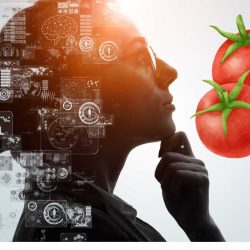
Be the Organic Tomato
At one point during our conversation, Eric and I found ourselves talking about tomatoes. It may seem like an odd detour in a discussion about artificial intelligence, but it ended up becoming the perfect metaphor.
We’ve all bought those flawless tomatoes sitting in neat rows at the grocery store. They are perfectly round, perfectly red, and perfectly disappointing. They look beautiful until you cut into them, only to discover that they have almost no flavor.
Then there are the tomatoes that come from a local garden or a farmers market. They may be slightly crooked or uneven in color, but the first bite reminds you what a tomato is actually supposed to taste like.
Writing is remarkably similar.
As more AI-generated articles, emails, books, and social media posts flood the internet, readers will become increasingly surrounded by prose that is technically correct, easy to digest, and strangely forgettable. Much of it will sound polished because it follows familiar patterns. It will also sound increasingly alike.
Authenticity has never been more valuable.
The imperfections that many writers spend years trying to eliminate—the unusual turn of phrase, the unexpected observation, the dry sense of humor, the vulnerability that occasionally makes us uncomfortable—are often the very qualities that allow readers to form a genuine connection with our work. Those are not flaws to be polished away. They are fingerprints.
Readers may not always be able to explain why one book lingers in their mind while another disappears as soon as they close it, but they instinctively recognize authenticity when they encounter it.
Use AI as a Tool, Not a Ghostwriter
None of this means authors should avoid AI altogether. Like spellcheck, grammar software, or search engines before it, AI can become another useful tool in the creative process if we remain intentional about how we use it.
Eric described using it primarily for research, brainstorming, and editing. I use software such as ProWritingAid to catch grammar and punctuation issues before sending a manuscript to a human editor. Those tools save time, reduce unnecessary mistakes, and allow us to focus our energy where it matters most.
The danger arises when convenience quietly becomes dependency.
If we begin asking AI not only to research our ideas but also to generate them, shape our arguments, write our chapters, and determine our voice, we gradually hand over the very work that makes writing meaningful. We may finish a manuscript more quickly, but we also risk creating something that could have been written by anyone.
Every writer will have to decide where to draw that line. There isn’t a universal rule, and there probably never will be. Some authors may choose not to use AI at all. Others will incorporate it into certain stages of their workflow. What matters is not whether AI touched the manuscript somewhere along the way. What matters is whether readers still encounter a distinctly human voice when they open the book.
Don’t Panic
Perhaps the most valuable advice Eric offered during our conversation had nothing to do with prompts, software, or technology. It was simply this: don’t panic.
Fear has always been an effective marketing strategy. Every week someone announces that AI will replace writers, editors, marketers, publishers, or virtually every other profession connected to books. At the same time, countless advertisements promise that a single AI tool can help anyone write bestselling books with almost no effort. Both messages appeal to our emotions far more than they reflect reality.
Publishing has never stood still. Typewriters gave way to computers. Spellcheck became part of every writer’s workflow. Self-publishing transformed who gets to tell stories and how those stories reach readers. AI is another chapter in that evolution, and like every tool that came before it, it can either serve the creative process or distract us from it. The difference depends less on the technology itself than on the choices we make as writers.
Technology will continue to evolve, and we will continue adapting alongside it. But no algorithm can replace the wisdom earned through lived experience, the vulnerability required to tell the truth, or the courage to express an idea that doesn’t sound like everyone else’s. In a world increasingly filled with polished, predictable content, those qualities may become a writer’s greatest strength. So by all means, use AI where it genuinely serves your work. Just don’t let it smooth away the very voice your readers came to hear. Be the organic tomato.
future belongs to writers who refuse to sound like everyone else.